
In whole-house custom renovation, selecting the right board material is a crucial step. As the surface finish plays a key role in both the appearance and protection of the board, it directly determines the cabinet’s aesthetic appeal, durability, and environmental friendliness.
I. Basic Structure of Panels (Understand the Basics First, Then Choose the Finish)
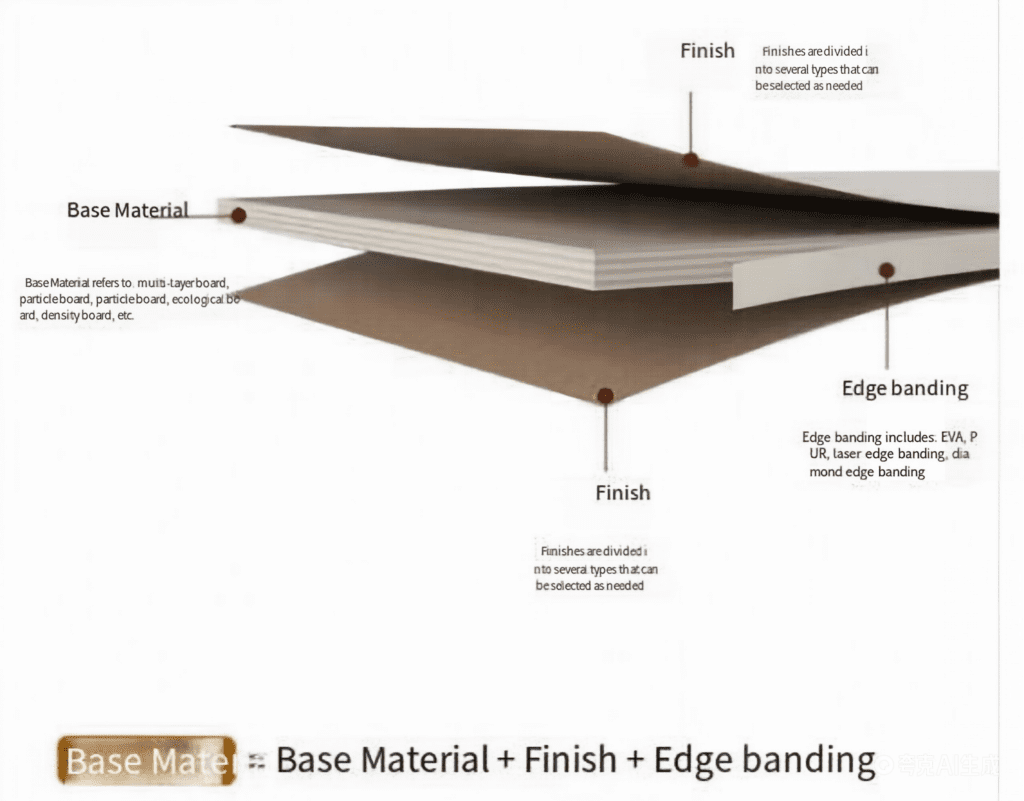
A fully customized board consists of three components, which work together to determine the board’s quality:
Substrate: The core carrier material, commonly including multilayer boards, OSB boards, particle boards, density boards, and eco-friendly boards.
Finish: The surface decoration and protective layer of the board are the core focus of this science popularization effort.
Edge banding: The edge-sealing process for board materials—common methods include EVA edge banding, PUR edge banding, laser edge banding, and diamond edge banding.
Basic panel = substrate +surface finish + edge banding
Only when these three components are appropriately combined can we achieve an optimal balance among aesthetics, durability, and environmental friendliness.
II. A Comprehensive Analysis of the Three Major Mainstream Finishes
1.Melamine-faced (melamine paper)
Process principle: Decorative paper with printed patterns is immersed in melamine resin liquid, then impregnated and dried to produce melamine-faced paper. This paper is subsequently hot-pressed onto the surface of a substrate under high temperature and pressure.
Common textures: wood grain, stone grain, skin-like texture, and linen finish.
Compatible substrates: Multilayer boards, OSB boards, particle boards, eco-friendly boards
Core advantages:
● High fidelity in surface texture reproduction, with a wide variety of styles to choose from.
● Excellent wear and scratch resistance—hardly gets damaged with daily use.
● Has good water resistance and is suitable for most home settings.
●High cost-effectiveness, making it the mainstream choice for whole-house customization.
Existing shortcomings:
●High requirements for edge-banders and processing techniques
● Limited design flexibility, making it difficult to create complex and unconventional shapes.
Applicable scenarios: wooden doors, cabinet bodies, cabinet doors, kitchen cabinets, wall-mounted cabinets, wood veneer wall panels.
2.PET finish
Process Principle: A food-grade PET (polyethylene terephthalate—same material as mineral water bottles) film is applied to the substrate surface via a hot-pressing process, offering outstanding environmental friendliness and safety.
Common textures: skin-feel, high gloss
Compatible substrates: MDF, particleboard, OSB
Core advantages:
● High environmental protection rating, excellent safety, odorless and healthier
● Stain-resistant, abrasion-resistant, and easy to clean—stains wipe right off.
● The surface is smooth and damaged, with a long service life.
● Highlight/Texture with a high-end skin feel, suitable for modern light-luxury styles
Existing shortcomings:
● Difficult to create complex shapes.
● Raw material and processing costs are relatively high, resulting in a pricing that is higher than that of melamine-faced products.
Applicable scenarios: Cabinets, cabinet doors, kitchen cabinets, bathroom vanities, wall-mounted cabinets (scenarios requiring moisture resistance and stain resistance).
3.PVC-coated finish
Process Principle: Using polyvinyl chloride (PVC) film as the raw material, the vacuum thermoforming process is employed to uniformly cover and thermally bond the PVC film onto the substrate surface under negative pressure, enabling the integrated molding of door panel shapes and surface finishes.
Common textures: matte, wood grain, sculpted surface
Compatible substrates: MDF, plywood
Core advantages:
● Outstanding moisture resistance, effectively preventing moisture vapor from penetrating.
● Highly malleable, enabling the creation of complex shapes such as irregular forms and carved patterns;
● The surface is wear-resistant and dirt-resistant, making daily cleaning and maintenance convenient. Additionally, the edge sealing is seamlessly integrated, reducing the likelihood of seam openings.
Existing shortcomings:
● Has poor high-temperature resistance; prolonged exposure to high temperatures can easily cause deformation and discoloration of the membrane surface.
● Some low-end products have moderate environmental performance and require attention to their environmental certification level; their cost is relatively high.
Applicable scenarios:cabinets, wardrobes, wine cabinets, desks
4.Solid wood veneer
Process principle: Solid wood veneer finishing uses natural logs as raw materials, which are processed into thin wood sheets through steps such as slicing, soaking, and drying. These thin wood sheets are then applied onto the surface of a substrate using a high-temperature hot-pressing and gluing process.
Common textures: The natural grain and color of raw wood.
Compatible substrates: Particleboard, MDF, plywood, eco-board, solid wood board
Core advantages:
● Excellent environmental performance, capable of achieving a natural texture close to that of solid wood;
● High fidelity in texture reproduction and strong adaptability to various styles;
● The texture is warm, smooth, and comfortable, and personalized color adjustments can be achieved through color-retouching techniques.
Existing shortcomings:
● It has high requirements for processing techniques and is prone to issues such as glue separation and blistering.
● Has relatively weak waterproof and fire-resistant performance; prolonged exposure to humid or high-temperature environments can easily lead to deformation and cracking.
● Requires regular maintenance to preserve surface texture and extend service life.
Applicable scenarios:High-end custom cabinets, solid wood doors, and wall panels.
5.Painted finish
Process principle: This is a high-end painting process involving multiple coats of paint applied to the substrate surface, followed by high-temperature baking and curing to achieve the final form. The process is highly complex.
Common textures: matte, glossy
Compatible substrates: MDF, solid wood boards
Core advantages:
● Excellent waterproof and fire-resistant performance, with strong sealing capability.
● High surface finish with a delicate and smooth feel.
● Easy to care for and clean, with no sanitary dead spots.
● High-end visual texture, compatible with high-end custom styles.
Existing shortcomings:
● The process is complex and the production cycle is long.
● The surface is susceptible to sharp impacts and scratches, leaving marks easily.
● High costs, with overall construction costs relatively high.
Applicable scenarios: wooden doors, wardrobes, kitchen cabinets, wall-mounted cabinets, wine cabinets, bathroom cabinets, staircases.
III. Summary: Choose the right model as needed to avoid pitfalls.
🟥 Pursue high cost performance, durability, and practicality: Prioritize melamine (melamine paper) finishes.
🟥 Prioritize eco-friendly safety, minimalist sophistication, and easy cleaning: Choose PET finishes as your top priority.
🟥 Prefers high-end texture, waterproof and fire-resistant properties, and a smooth tactile feel: Opt for baked-paint finishes first.