
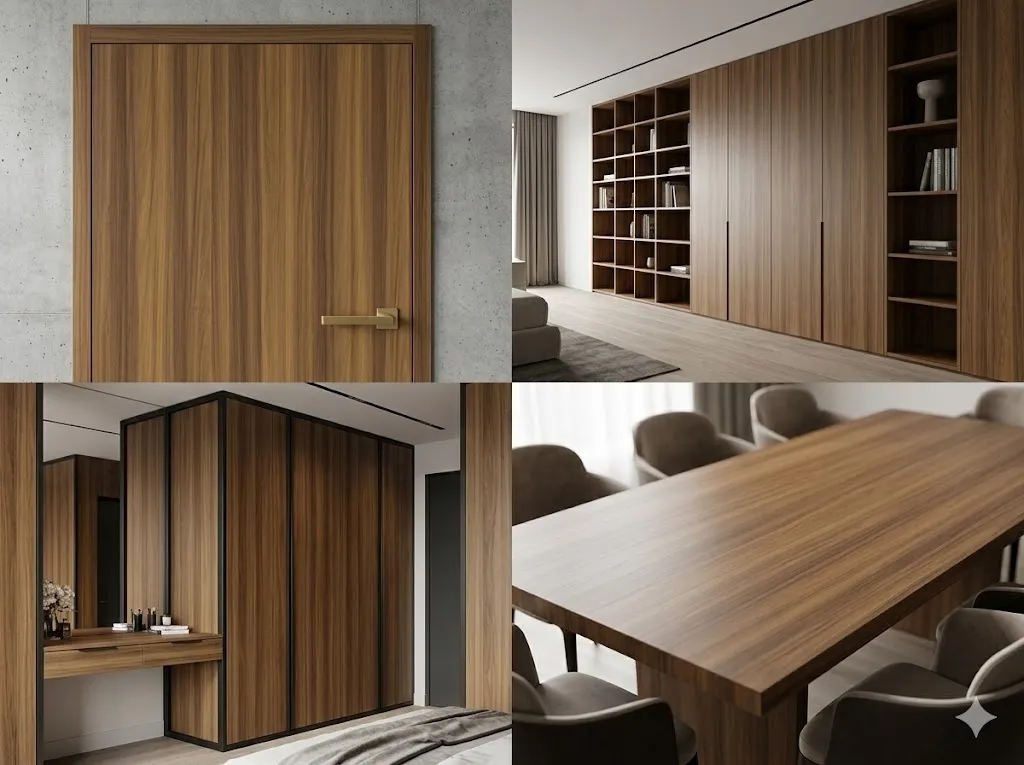
Melamine board, formally known as melamine-impregnated decorative paper-faced man-made board, is a composite decorative panel made by using a man-made board as the substrate and covering its surface with a film of paper that has been impregnated with melamine resin and then dried. The panel is formed through high-temperature and high-pressure hot pressing. In the industry, it is also referred to as “melamine board” or “paint-free board.” Its core manufacturing process consists of four major stages: substrate preparation, impregnation paper processing, hot-pressing and lamination, and post-processing. Technical parameters and quality control directly determine the final performance of the board.
I. Core Composition and Substrate Selection
Melamine boards consist of two core components: a substrate and a decorative surface layer. These two components work together to achieve a seamless integration of structural strength and aesthetic appeal.
Base materials: Common types include particleboard, medium-density fiberboard (MDF), plywood, and solid wood boards. These materials must meet basic requirements such as uniform density, stable moisture content (8% to 12%), and adequate internal bond strength. The base material provides the core structural support for the board, and its quality directly affects the finished board’s resistance to deformation and durability.
Surface layer: Composed of multiple layers of functional papers, arranged from top to bottom as follows: surface paper (transparent and wear-resistant, providing physical protection); decorative paper (printed with wood grain, stone patterns, solid colors, etc., determining the overall aesthetic appearance); overlay paper (specifically designed for light-colored boards, masking any color differences in the substrate); and base paper (impregnated with phenolic resin to enhance adhesion to the substrate). The key material of the surface layer is melamine-formaldehyde resin (MF resin), which is synthesized through the polycondensation of melamine and formaldehyde. After curing, it forms a hard, dense protective film.
II. Core Process Full Flow
(1) Impregnation Paper Processing: Resin Penetration and Curing Control
1.Gel Preparation and Mixing: Prepare melamine-formaldehyde resin by adding curing agents, mold release agents, stabilizers, and other additives according to specified proportions. Adjust the solid content (35%–45%) and viscosity of the resin to ensure uniform impregnation.
2.Gel Preparation and Mixing: Prepare melamine-formaldehyde resin by adding curing agents, mold release agents, stabilizers, and other additives according to specified proportions. Adjust the solid content (35%–45%) and viscosity of the resin to ensure uniform impregnation.
3. Gradient Drying: The material undergoes multi-zone hot-air drying (with temperature control in three stages: 80℃ → 130℃ → 110℃) to remove moisture and volatile substances, while controlling the volatile content (≤0.8%) and pre-curing degree (40%–60%). This prevents wrinkling of the paper surface and over-curing of the resin. After drying, a semi-solid胶 film paper is formed, ready for hot-press lamination.
(2) Thermal Pressing: High-Temperature, High-Pressure Molding
1.Laying and aligning the layers: Precisely align and lay the surface paper, decorative paper, overlay paper, base paper, and substrate according to design specifications, ensuring that there is no misalignment or air bubbles between the layers.
2.Hot-pressing parameter control: A short-cycle, low-pressure veneering process is employed, with temperature controlled between 120 and 180℃, pressure set at 3 to 5 MPa, and holding time ranging from 30 to 90 seconds. The high temperature promotes complete curing of the resin through cross-linking reactions, while the high pressure ensures tight adhesion between the film paper and the substrate, forming an integrated structure.
3.Cooling and Shaping: After hot pressing, rapidly cool the material down to below 50℃ to relieve internal stresses within the board and prevent warping or deformation.
(3) Post-processing: Cutting and Edge Banding
1. Precision cutting: Cut to standard dimensions (e.g., 1220mm × 2440mm) or custom specifications, ensuring dimensional deviation ≤ ±0.5mm and edge perpendicularity ≤ 0.3mm.
2. Edge finishing: Use matching-color melamine edge banding or PVC edge banding, thermally fused and bonded using an edge-band machine. The edge banding thickness ranges from 0.6 to 2.0 mm, ensuring edge sealing, wear resistance, and aesthetic appeal while preventing the substrate from absorbing moisture and swelling.
III. Key Quality Indicators and Control
1.Physical Performance: The surface wear resistance must meet the Taber abrasion test requirement of ≥400 cycles with a weight loss of ≤0.08 g. Additionally, the material must pass the heat resistance test (no cracking after 30 minutes at 180℃) and the acid-alkali corrosion resistance test (no significant changes after immersion for 24 hours).
2.Environmental Standards: Formaldehyde emission levels must comply with national standards: E1 grade ≤ 0.124 mg/m³, E0 grade ≤ 0.05 mg/m³, and ENF grade ≤ 0.025 mg/m³. The environmental performance depends on the degree of resin curing and the environmental rating of the substrate; complete resin curing can significantly reduce the risk of formaldehyde residue.
3.Appearance quality: The surface has no obvious scratches, bubbles, color differences, or stains; the pattern is clear and lifelike, and the texture reproduction rate is ≥95%.
IV. Process Characteristics and Application Scenarios
The core advantages of melamine board technology lie in its paint-free, eco-friendly nature, efficient mass production, and versatile performance. It eliminates the need for secondary painting, thereby avoiding paint pollution and lingering odors. Moreover, its surface is highly resistant to abrasion, heat, stains, and easy to clean, making it ideal for high-frequency usage scenarios. Melamine boards are widely used in panel furniture (cabinets, wardrobes, desks), interior decoration (walls, partitions, cabinet doors), office furniture, children’s furniture, and other fields. In particular, when selecting melamine boards for children’s furniture, it is essential to prioritize those with ENF-level environmental certification to ensure user safety.
V. Directions for Process Optimization
The industry is moving toward higher environmental friendliness, greater abrasion resistance, and enhanced realism: adopting low-free-formaldehyde resin preparation technology to further reduce formaldehyde emissions; enhancing the abrasion resistance of surface finishes by incorporating nano-sized abrasion-resistant fillers; introducing AI-powered visual inspection and intelligent glue-mixing systems to achieve precise quality control; and developing new decorative papers with textures that mimic solid wood, metal, and other materials, thereby expanding the boundaries of decorative styles.
The melamine board process achieves an efficient bond between the substrate and the decorative surface layer by precisely controlling parameters at each stage—impregnation, hot pressing, and post-processing—while offering both structural stability and decorative versatility. It is one of the mainstream processes used in modern home decoration and furniture manufacturing.