
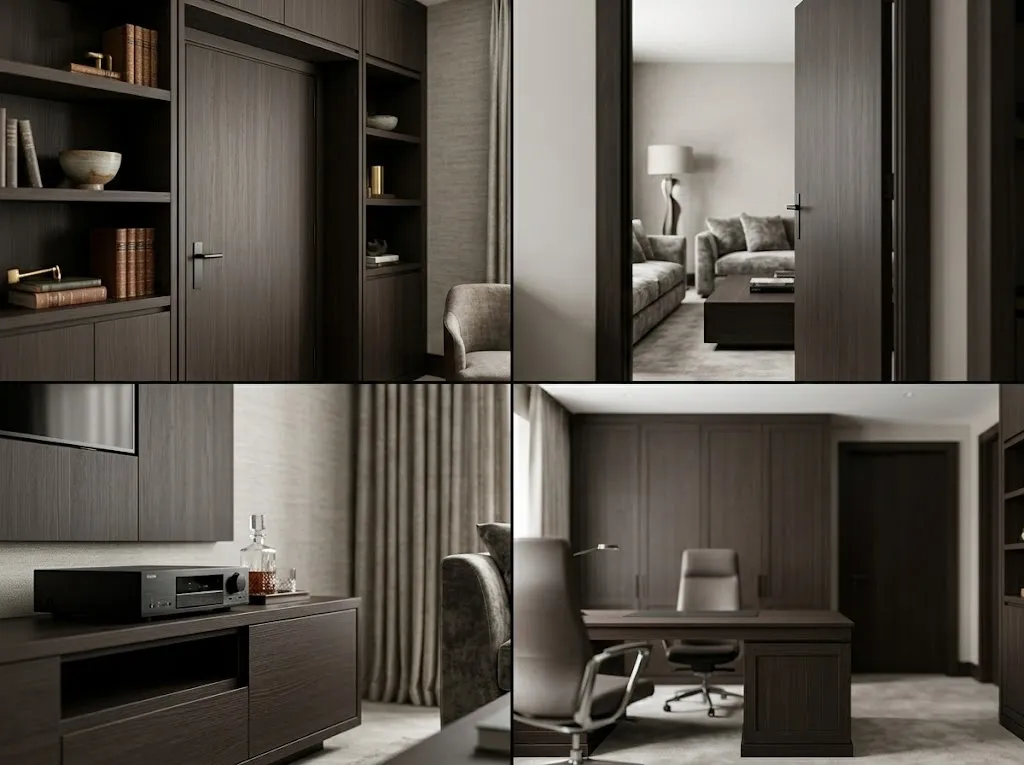
Currently, manufacturers are introducing a variety of fancy board names to meet marketing demands, often leaving consumers overwhelmed and confused when making choices. This article aims to strip away unnecessary marketing jargon and, drawing on industry expertise and practical experience, provide professional, easy-to-understand guidance on selecting the right boards from four key dimensions: appearance, environmental friendliness, performance, and price—helping consumers make informed and precise selections.
I. Aesthetic Dimension: Focus on the finish, not the core material.
The appearance, tactile experience, and surface durability of panels largely depend on the surface finishing process; the core material has minimal impact on visual appeal. Currently, the three main types of finishes that are both popular and practical in the market are as follows. You can choose based on your decorating style and specific needs:
· Melamine Finish (Double-Sided Finish): Its core advantages are wear resistance, scratch resistance, rich color options, and outstanding cost performance. It is the mainstream choice in the current whole-house customization market, suitable for various decoration styles, and balances practicality and economy.
· PET Finish: Divided into matte and high-gloss types, it has a smooth and delicate touch, high color saturation, pure color, and strong decorativeness. It is suitable for consumers pursuing a sense of high-grade space, minimalist style, or light luxury style, and is easy to clean and maintain.
· Quasi-Molecular/EB Finish: It has excellent scratch resistance and fingerprint resistance, with a delicate and high-grade surface texture. However, the production process is complex, the cost is high, and it is mostly used in high-end customization scenarios.
II. Environmental Protection Dimension: Related to Family Health, Recognize Authoritative Certifications
The environmental protection of wood panels is the core focus of selection. It is necessary to be alert to exaggerated marketing terms such as “zero formaldehyde” on the market. The core judgment basis is authoritative environmental protection level certification. Different levels correspond to different formaldehyde emission levels, suitable for different demand scenarios:
· New National Standard ENF Level: As one of the strictest environmental protection standards in the world currently, in accordance with the GB/T 39600-2021 standard, the formaldehyde emission is ≤0.025mg/m³, with the best environmental protection performance. It is suitable for maternal and child families, sensitive groups, and consumers with extremely high environmental protection requirements.
· Japanese F4 Star Level: It is an international top-level environmental protection standard. Its testing method is more stringent than the national standard, with higher requirements for formaldehyde emission control, and it is also an excellent choice for high-end environmental protection wood panels.
· E0 Level: It is a common mid-range environmental protection level in the market, with a formaldehyde emission of ≤0.050mg/m³. Its environmental performance can meet the needs of daily family use, with outstanding cost performance, and it is the mainstream choice for public consumption.
Supplementary Note: When purchasing, you need to ask the merchant to provide a third-party test report certified by CMA/CNAS to ensure that the environmental protection level of the wood panels is truly traceable.
III. Performance Dimension: Determined by the Base Material, Adapt to the Scenario
The core performance of wood panels, such as moisture resistance, load-bearing capacity, and anti-deformation ability, is mainly determined by the type of base material. Different base materials have significant differences in characteristics, and they need to be reasonably selected according to the environmental characteristics and functional needs of the use space. The details are as follows:
· Particle Board: The base material is made of wood particles pressed at high temperature and pressure. It has stable structure, is not easy to deform, and has high cost performance. It is the preferred base material for most well-known custom brands. It is suitable for cabinets and cabinet doors in dry areas such as wardrobes and bookcases. Its shortcoming is that its moisture resistance is average, so it is not suitable for use in humid environments.
· Multi-Layer Board (Plywood): It is made of multiple layers of veneer pressed alternately. It has excellent moisture resistance, strong nail-holding power, and stable mechanical performance. It is suitable for making cabinets in humid areas such as kitchens, bathrooms, and balconies. Its shortcoming is that it is not suitable for high cabinet doors, which are prone to deformation.
· OSB Board: Pressed by oriented strand board technology, it has a compact structure, extremely strong nail-holding power, outstanding anti-deformation and anti-cracking performance, and generally high environmental protection. It is one of the best base materials for flat cabinet doors and floor-to-ceiling designs. Its shortcoming is that the price is relatively high.
· Ecological Board (Joinery Board): Its performance mainly depends on the internal core material. Among them, the Chinese fir core ecological board has good nail-holding power and moderate price, suitable for making ordinary cabinets; its shortcoming is that its moisture resistance is average, so it is not suitable for high cabinet doors. It is recommended to choose products from large factories to ensure quality control.
· Density Board (Fiberboard): Made of wood fiber pressed, it has a smooth surface and is easy to process into shapes, suitable for making cabinet doors that need complex shapes; its shortcomings are poor moisture resistance and weak nail-holding power, so it is not suitable as a base material for cabinets.
IV. Price Dimension: Balance Budget and Needs, Scientific Matching for Higher Cost Performance
The price of wood panels is affected by many factors, mainly including brand, environmental protection level, surface finishing process, and panel thickness. When purchasing, there is no need to blindly pursue high prices. Instead, we should combine the budget and use needs to maximize cost performance. The specific suggestions are as follows:
· Limited Budget: Prioritize ENF-level wood panels from well-known domestic brands, which balance environmental protection and cost performance, can meet the needs of daily family use, and avoid paying for unnecessary brand premium.
· Pursuing Quality: Imported wood panels can be selected, which have more advantages in surface color design, production quality control, and environmental stability. They are suitable for consumers with high requirements for decoration quality, and need to accept their high price premium.
· On-Demand Matching: There is no need to use the same high-end wood panels for the whole house. They can be matched by area according to the use needs of different spaces. For example, multi-layer boards are used in humid areas, particle boards are used in dry areas, and PET finish or OSB boards are used for cabinet doors, which can not only ensure the use performance but also reasonably control the budget.
V. Core Reminders for Purchase
When purchasing wood panels, it is necessary to strip away marketing packaging and focus on core indicators: first confirm the environmental protection level and test report, select the base material according to the use scenario, choose the surface finish according to the decoration style and budget, and at the same time pay attention to checking the panel edge banding process (prefer PUR edge banding and laser edge banding), and clearly mark key information such as base material brand, environmental protection level, and surface finish type in the contract to avoid merchants replacing materials and protect their own rights and interests.